"Is it tomorrow yet?" "How many minutes is a long time?" "You said soon ages ago!" If you live with a 4-year-old, you hear some version of this every day. It isn't stubbornness. Time is invisible, it can't be touched, and the words we use for it — soon, later, in a minute, next week — are some of the vaguest in the language.
The good news: you don't need to teach a 4-year-old to read a clock to help them understand time. You need to make time concrete — something they can see, count or feel in their own day. This guide covers how to explain time to a 4 year old with words, routines and pictures they already understand, and what to leave until later.
What a 4-Year-Old Understands About Time (and What They Don't)
Every child is different, but most 4-year-olds have a decent grip on order: breakfast comes before preschool, bath comes before bed, the story comes after pyjamas. They know the shape of their own day, especially when it's predictable.
What they usually don't have yet is a sense of duration or distance in time. Ten minutes and an hour feel about the same. "Yesterday" might mean last week, and "tomorrow" might mean any time in the future. It's very common for a 4-year-old to say "I did that yesterday" about a holiday three months ago. That's not a mistake to correct sharply — it's a sign they've grasped that some things are in the past, which is the first step.
Reading an analogue clock comes much later. In the US, for example, the Common Core maths standards introduce telling time to the hour and half hour in first grade, when most children are 6 or 7. If you want the full age-by-age progression, our teaching kids to tell time guide walks through it. At 4, the job is laying the foundations: order, anchors and a feel for "how long".
Start With Order: First, Then, Last
Sequence is the easiest part of time for a preschooler to grasp, so build from there. Use the same three words, every day, about things that really happen:
- "First shoes, then coat, then we go to the car."
- "First bath, then pyjamas, last one story."
- "First we tidy the blocks, then it's snack."
Two steps is plenty for a younger 4-year-old; three works well for most. Saying it out loud also gives your child something to hold onto when they ask "when?" — the answer is "after the next thing", which is far easier to understand than "in twenty minutes". A simple first-then board with two pictures makes the same idea visible, and many children love moving the card when a step is done.
Answer "when?" with an event, not a number. "We'll see Grandma after lunch" lands. "We'll see Grandma at two o'clock" doesn't — yet. Swap minutes and hours for the things in your child's day, and the questions drop noticeably.
Explaining Time to a 4 Year Old With Anchors They Already Know
Adults measure time in minutes and hours. Four-year-olds measure it in things they've lived through. Borrow their units:
- Sleeps for days: "Three more sleeps until your birthday." This works far better than "on Saturday".
- Meals for parts of the day: "After breakfast", "before dinner".
- Songs for very short spans: brushing teeth takes "about one song" (most children's songs run two to three minutes).
- Familiar activities for longer spans: "As long as one episode of your show" is a clearer picture of 20 minutes than the number 20.
Pick one anchor per job and use it consistently. If "one song" means tooth-brushing time, keep it that way — changing the measure every day undoes the learning.
How to Explain How Long "5 Minutes" Is
Duration is the hard part, and it's where most arguments start. "Five more minutes" means nothing to a child who can't feel five minutes passing — our piece on why "5 minutes" means nothing to kids goes into the reasons. The fix is to make duration visible.
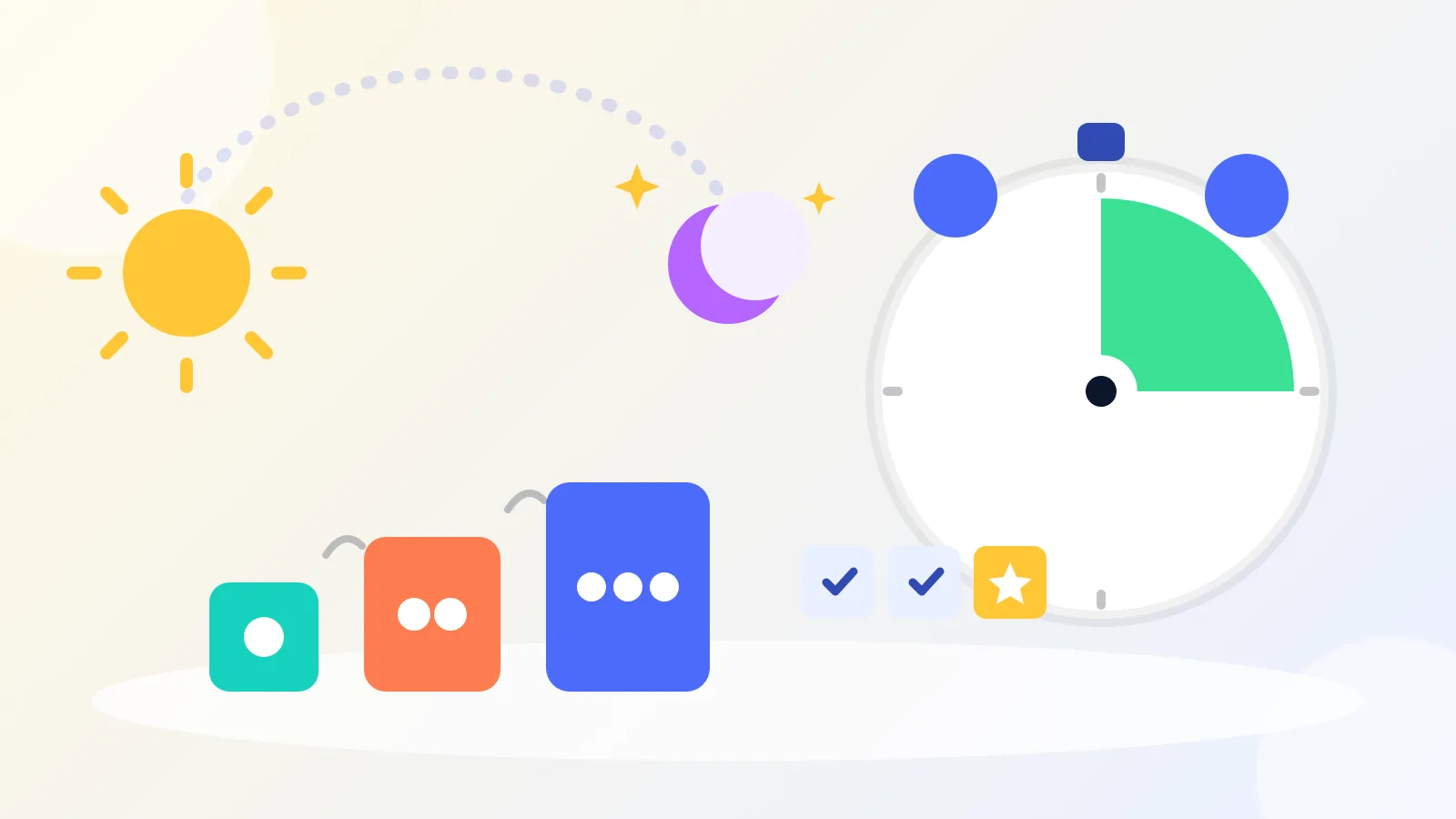
A visual timer does exactly that: a coloured shape that shrinks as time passes. Your child doesn't need numbers. They can see that "most of the colour is left" or "it's nearly gone". Over weeks, they start to connect that picture with how long things feel.
A few ways to practise without turning it into a lesson:
- Time something fun. "Let's see how much colour is left after you build one tower." Children learn duration faster when the time is enjoyable, not just when it's a deadline.
- Use the same few lengths. 1, 2 and 5 minutes cover most of a 4-year-old's day. Our 5 minute timer guide has ideas for using that length well.
- Narrate it, briefly. "Half the colour's gone — halfway through." Then stop talking and let the timer do the work.
- Give a warning before the end. "When the colour is nearly gone, it's time to put the cars away." The warning is where most of the learning happens.
This is what Tokimo was built for: a countdown shown as a shrinking shape with an animated character, so a child who can't read numbers can still see how much time is left. It's free to download on iPhone and iPad. If you're comparing tools first, our visual timers for kids page covers what to look for.
Yesterday, Today and Tomorrow: Teaching Time Words
"Yesterday" and "tomorrow" take a while. Most children use them loosely for a long time before they use them accurately. You can speed things up a little by tying the words to sleep, which is the natural boundary between days for a small child:
- Yesterday = "before you went to sleep last night".
- Today = "now, until you go to sleep tonight".
- Tomorrow = "after you wake up".
A countdown chart helps with bigger gaps. For a birthday or trip, draw one square per sleep and let your child cross one off each morning. It turns an abstract "next week" into something they can count down with their finger — and it cuts the "is it today?" questions dramatically. A weekly visual schedule with a picture for each day (swimming on Tuesday, Grandma on Saturday) does the same for the regular week.
Don't worry about the names of the days or months yet. Plenty of 4-year-olds can recite them as a song without connecting them to real time, and that's fine. Understanding comes from living the routine, not from the list.
Phrases to Swap: Vague Time Words vs Clear Ones
Much of the confusion comes from us, not them. Here are common phrases and what to say instead:
The pattern is always the same: replace a number or a vague word with an event your child has lived through, or a picture they can see.
Waiting: Helping a 4-Year-Old With "Later"
Waiting is where understanding time stops being abstract. A child who can't picture how long a wait is will ask again and again, because asking is the only way they have to check. Make the wait visible and countable — a timer for short waits, sleeps for long ones — and the questions shift from "Is it time yet?" to "Look, it's nearly gone!"
Keep early waits short and winnable: one or two minutes for a turn on the swing, not fifteen. Success builds tolerance. Our guide to teaching kids patience has more ideas for stretching waits gradually.
Try it this week. Pick one daily moment where "when?" causes trouble — the end of playtime, or waiting for dinner. Answer it with "first, then", and put a visual countdown where your child can see it. Download Tokimo to give that moment a timer your 4-year-old can read without numbers.
Frequently Asked Questions
Can a 4 year old understand time?
Partly. Most 4-year-olds understand order — what comes before and after in their day — and use words like "yesterday" and "tomorrow", often loosely. A sense of how long things take, and reading a clock, usually come later. You can help by linking time to events, sleeps and visual timers rather than numbers.
How do I explain minutes to a 4 year old?
Don't rely on the number. Show it with a visual timer whose colour shrinks as the minutes pass, and tie the length to something familiar, like "about one song" for two minutes. Using the same few lengths, such as 1, 2 and 5 minutes, helps a preschooler start to feel the difference.
When should a child learn to tell time on a clock?
Most children start reading o'clock and half past around age 6 or 7, when school introduces it. Before that, focus on sequence, daily anchors and visual timers. Pushing clock-reading at 4 rarely sticks and can make time feel harder than it is.